You saw the word “skink” somewhere — maybe on a nature show, maybe in a Scottish recipe, maybe in an old poem — and now three completely different pictures are fighting in your head: a lizard, a drink, and a bowl of soup.
Here’s the relief: you’re not confused because you misread something. You’re confused because “skink” is genuinely three things at once, and almost every guide online only tells you about one of them and calls it a day.
This one won’t. We’ll cover the real animal, the almost-forgotten Scottish word it’s tied to, the actual dish named after it, and — because so many readers of this site are working on their English grammar — exactly how to use “skink” correctly as a noun, a verb, and in a sentence without tripping over it.
Quick Answer: What Does Skink Mean?
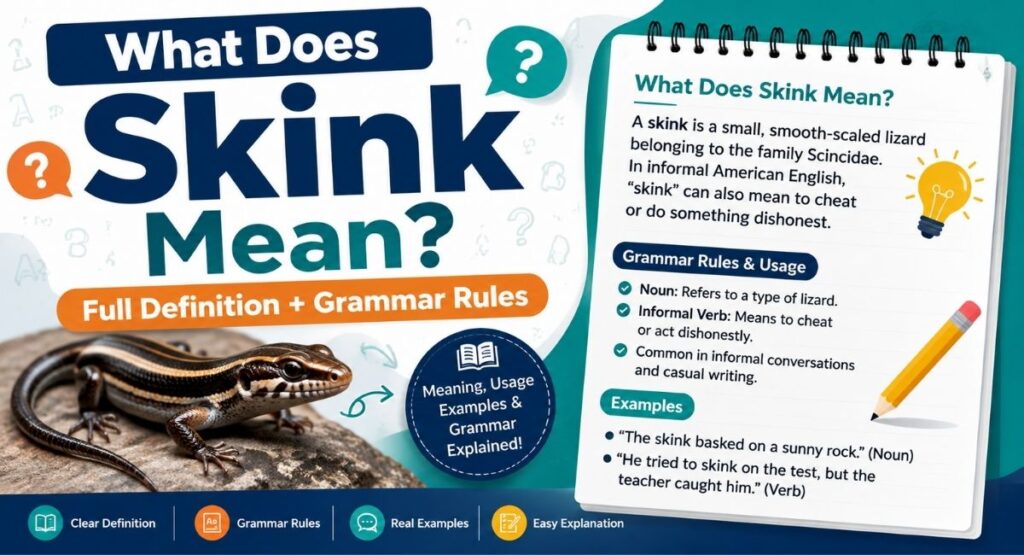
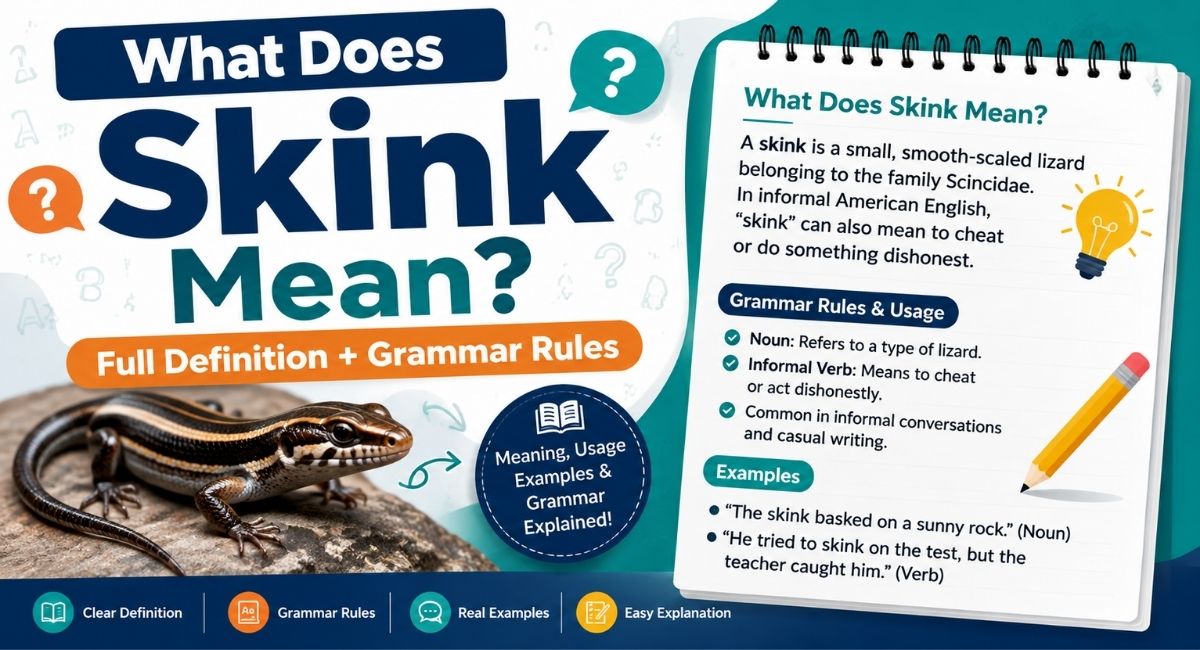
Skink most commonly means a small, smooth-scaled lizard from the family Scincidae. In Scottish English, “skink” is also an old verb meaning to pour or serve a drink, and it’s the root of Cullen skink, a traditional Scottish smoked-fish soup that has nothing to do with the lizard at all.
Three meanings, one spelling. That’s the whole puzzle — let’s unpack each piece properly.
Meaning #1: Skink the Animal (The Most Common Use)
In everyday English — science class, documentaries, casual conversation — “skink” refers to a real reptile, not slang and not an insult.
Key facts about the animal:
- It belongs to the lizard family Scincidae, one of the largest reptile families on Earth, with well over a thousand recognized species.
- Skinks have smooth, glossy scales — noticeably shinier than the rough, bumpy skin of geckos or iguanas.
- Most species have short legs, and a few have legs so reduced they’re barely visible, which is why people occasionally mistake them for snakes.
- The real giveaway between a skink and a snake: skinks have movable eyelids and visible ear openings. Snakes have neither.
- They’re cold-blooded, so you’ll usually spot them basking on rocks, patios, or garden walls to regulate their body temperature.
Why this matters practically: if you’re a gardener, this is genuinely useful — skinks eat ants, beetles, and other small insects, so they’re doing pest control for free. Most of the “lizard” sightings people report around U.S. homes in warmer states are actually skinks, not geckos, which is a mix-up worth clearing up if you’re trying to identify what’s living in your yard.
Meaning #2: Skink the Verb (Old Scottish English)
This is the part almost every other guide either skips or gets wrong.
In Scottish and older British English, “skink” was a verb meaning to pour out or serve drink — think of someone filling cups with ale at a feast. It comes from Old English/Old Norse roots and has zero connection to the lizard; the two words just happen to look and sound identical.
This is a textbook example of a homonym: two words, same spelling and pronunciation, completely unrelated meanings and origins.
A related word you might recognize from older literature — including Shakespeare — is “skinker,” meaning a bartender or someone who pours drinks. If you’ve ever read a footnote in an old play explaining what a “skinker” was, this is the same word family.
Meaning #3: Cullen Skink (The Soup Nobody Else Explains)
Here’s a real gap in most articles on this topic: Cullen skink is an actual, well-known Scottish dish, and it’s directly named after the pouring/serving sense of the word — not the lizard.
Cullen skink, quick facts:
- It’s a thick Scottish soup traditionally made from smoked haddock, potatoes, onions, and milk or cream.
- It’s named after the town of Cullen, in Moray, Scotland.
- The “skink” in the name reflects the old sense of the word tied to serving a hot, poured dish — not the animal.
If you’ve searched “skink meaning” after seeing this word on a menu or a recipe site, this is almost certainly what you were looking for — and it’s a completely different word history from the lizard, even though it’s spelled the same.
Pronunciation Guide: How to Say “Skink” Correctly
This word trips up a lot of English learners because it looks like it should be two syllables. It isn’t.
- Phonetic spelling: skink
- IPA: /skɪŋk/
- Syllables: 1 (one syllable — say it in a single beat)
- Rhymes with: think, pink, sink, link
How to say it: Start with the “sk” sound (like in “skip”), then “ih” (like in “sit”), then finish with “ngk” (like the end of “think”). One smooth sound, no breaks.
Skink Grammar Breakdown (For English Learners)
This is the section most competing guides don’t bother with — and it’s exactly where grammar mistakes actually happen.
Skink as a Noun
| Form | Example | Notes |
| Singular | “A skink ran across the path.” | Standard countable noun |
| Plural | “Several skinks live under that log.” | Regular plural — just add “-s” |
| Possessive | “The skink’s tail grew back.” | Apostrophe + s, standard rule |
Common mistake: People sometimes write “skinks'” (plural possessive) when they mean a single skink’s possession. Rule of thumb: if it’s one skink owning something, it’s skink’s; if it’s multiple skinks, it’s skinks’.
Skink as a Verb (Archaic / Scottish Usage)
| Tense | Form | Example |
| Present | skink | “They skink the ale into cups.” |
| Past | skinked | “He skinked wine for the guests.” |
| Present participle | skinking | “She was skinking drinks all evening.” |
| Agent noun | skinker | “The skinker filled every glass.” |
Important note: This verb form is archaic. You will not use this in modern conversation or writing — it’s included here purely so that if you encounter it in older literature, poetry, or historical fiction, you recognize it instead of assuming it’s a typo or slang.
Capitalization Rules
- skink (the common word, animal or verb) — always lowercase, unless it starts a sentence.
- Scincidae (the scientific family name) — always capitalized and italicized, because it’s a formal taxonomic name.
- Cullen skink (the dish) — “Cullen” is capitalized because it’s a proper noun (a place name); “skink” stays lowercase.
Common Mistakes People Make With “Skink”
- Confusing it with “skunk” — a completely different animal (a mammal known for its spray), not a reptile. The words just look alike on paper.
- Assuming it’s always slang — it isn’t. In standard English, it’s a formal biological term, not casual internet speak.
- Mispronouncing it as two syllables — it’s one syllable: /skɪŋk/, not “skee-ink.”
- Using the archaic verb form in modern writing — “skink” as a verb will sound wrong or confusing to a modern reader; stick to the noun (lizard) sense unless you’re deliberately writing in an old or literary style.
Where the Word Comes From: Etymology
The animal sense traces back through Latin “scincus” to Greek “skinkos,” both referring directly to the lizard — this line of meaning has stayed essentially unchanged for centuries.
The verb sense (to pour drink) developed separately in Old English and Old Norse (“scencan”), with no shared root with the Latin/Greek lizard word. The two simply collided into the same spelling over time — which is exactly why the confusion exists today.
Skink vs. Similar Words: Quick Comparison
| Word | What It Means | Related to Skink? |
| Skunk | A mammal known for its defensive spray | No — different animal, similar spelling only |
| Basilisk | A larger, crested lizard known for running across water | No — different family (Corytophanidae), just both lizards |
| Lizard | The broad umbrella term for reptiles like skinks, geckos, iguanas | Yes — skink is one specific type of lizard |
| Cullen skink | A Scottish smoked-fish soup | Yes — named from the old “pour/serve” sense of the word |
Easy way to remember it: every skink is a lizard, but not every lizard is a skink. Think of “lizard” as the category and “skink” as one specific member of it — smooth-scaled, short-legged, and fast-moving.
How to Use “Skink” in a Sentence
| Sentence | Grammar Note |
| The skink darted under the rock. | Singular noun + regular past-tense verb |
| We spotted three skinks basking in the sun. | Plural noun, present participle “basking” |
| The skink’s tail regrew within weeks. | Singular possessive |
| Historically, servants would skink wine at feasts. | Archaic verb usage — literary/historical context only |
Fun Facts Worth Knowing
- Many skinks can deliberately drop their tails to escape predators — a defense mechanism called autotomy. The tail regrows, though usually a slightly different shade.
- Some skink species give live birth instead of laying eggs, which is unusual among reptiles.
- Because of their insect-heavy diet, skinks are considered genuinely useful to have around gardens and farmland.
Why Getting the Skink Meaning Right Actually Matters
This isn’t just trivia. If you’re an English learner, mixing up “skink” (noun, lizard) with “skink” (archaic verb) in writing can make a sentence sound confusing or outdated without you realizing why. And if you’ve ever seen “Cullen skink” on a menu and assumed it involved lizard meat — it doesn’t, and now you know exactly why the name exists.
Getting the grammar right — noun vs. verb, singular vs. possessive, when a word is capitalized — is what actually helps you use new vocabulary confidently, not just recognize it when you see it.
Frequently Asked Questions
What does skink mean?
A skink is most commonly a small, smooth-scaled lizard from the family Scincidae, found in warm regions worldwide.
Does “skink” mean to pour out a drink?
Yes — but only in an old, mostly extinct sense. In Scottish and older British English, “skink” was a verb meaning to pour or serve drink. This usage is archaic and not used in modern conversation.
What is Cullen skink?
Cullen skink is a traditional Scottish soup made with smoked haddock, potatoes, onions, and cream, named after the town of Cullen in Scotland — unrelated to the lizard.
Is “skink” a noun or a verb?
It can be both. As a noun, it refers to the lizard (its common modern use). As an archaic verb, it means “to pour or serve drink,” a usage now limited to historical or literary contexts.
How do you pronounce skink?
“Skink” is pronounced /skɪŋk/, one syllable, rhyming with “think” and “pink.”
Is a skink dangerous to humans?
No. Skinks are shy, non-venomous, and avoid confrontation. They’re harmless even in the rare case one bites when startled.