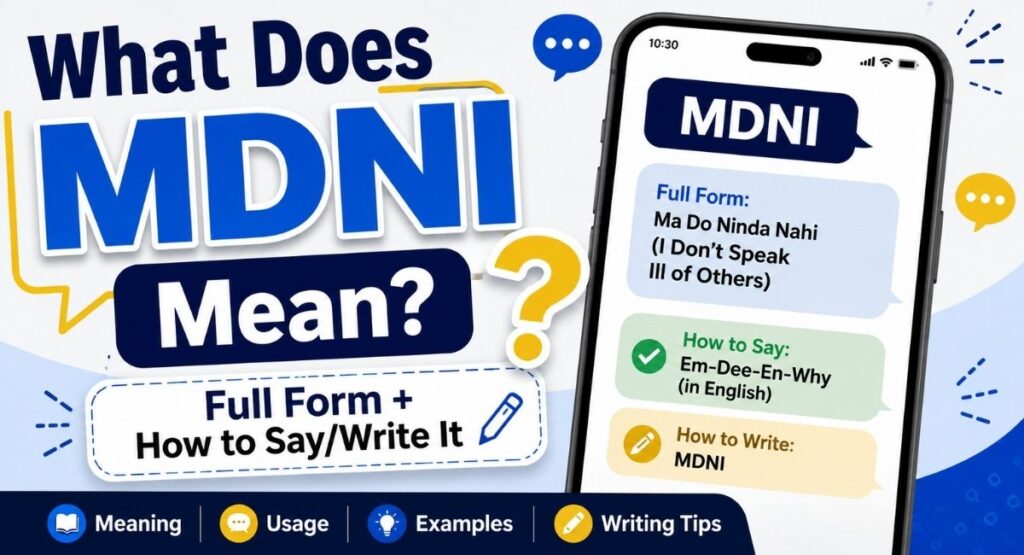
You saw “MDNI” in someone’s bio and now you’re stuck. Is it an abbreviation? A typo? A weird inside joke you’re not part of?
Take a breath — you’re not missing anything obvious. MDNI is one of those internet terms that looks like alphabet soup until someone actually breaks it down for you. That’s what this guide does: the full form, how to say it out loud, how to write it correctly, and the grammar rules almost nobody explains.
Quick Answer: MDNI Meaning in One Line
MDNI stands for “Minors Do Not Interact.” It’s a boundary notice — usually written by adult account owners — telling anyone under 18 not to follow, comment, message, or otherwise engage with their profile or content.
It’s not slang for fun. It’s a warning label, similar in spirit to an age-restriction sign at a store entrance.
MDNI Full Form and Part of Speech
Here’s where most explainer articles stop short — they tell you what MDNI means, but not how it actually functions grammatically in a sentence. If you’re not a native English speaker, this part matters more than it looks.
Full form: Minors Do Not Interact
Part of speech: MDNI is an initialism (not an acronym — more on that difference below), and it functions as a noun phrase when used on its own, or as an imperative statement when read as its full form.
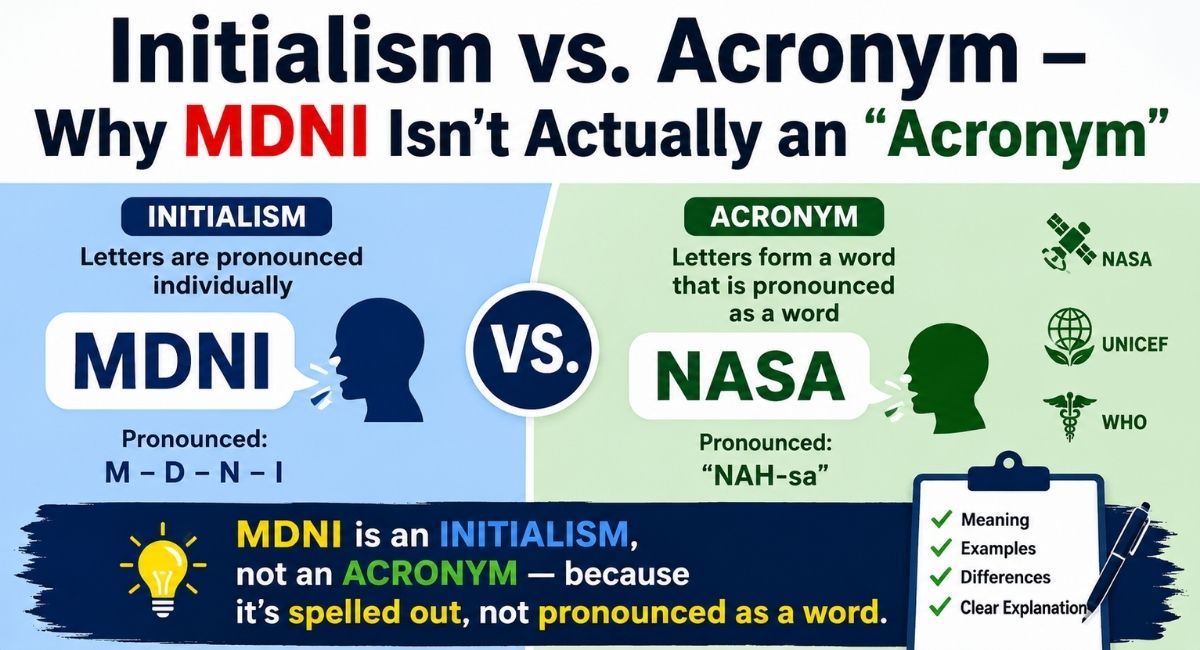
Initialism vs. Acronym — Why MDNI Isn’t Actually an “Acronym”
People casually call MDNI an “acronym,” but that’s technically incorrect, and it’s a mistake worth fixing if you write or teach English:
- An acronym is pronounced as a word (like NASA, said “nah-sa”).
- An initialism is pronounced letter by letter (like FBI, said “eff-bee-eye”).
MDNI falls into the second category. You say each letter individually — you don’t try to pronounce it as a single word. Getting this distinction right is a small thing, but it’s exactly the kind of grammar nuance that separates a careful writer from someone guessing.
How to Pronounce MDNI
Say it as four separate letters: “M-D-N-I” (em-dee-en-eye).
There’s no shortcut pronunciation, no blended sound, and no regional variation worth noting — unlike acronyms that sometimes get nicknamed, MDNI is always read letter by letter, in both casual speech and when creators explain it out loud in videos.
Capitalization Rules for MDNI
This is a small detail that trips up a lot of non-native English writers, so let’s be precise about it:
- MDNI is always written in full capital letters — never “Mdni” or “mdni” in formal contexts, since it’s an initialism representing a phrase, not a regular word.
- On casual platforms like TikTok captions or Discord chats, you will see it lowercase (“mdni”) — this is stylistic, not grammatically “correct,” but it’s widely accepted informally.
- When spelling out the full form, standard sentence capitalization applies: “Minors Do Not Interact” at the start of a sentence, or lowercase mid-sentence (“this account uses minors do not interact language”) — though most writers keep all three words capitalized for clarity, since it functions as a fixed phrase.
Rule of thumb: capitalize MDNI itself always; treat “Minors Do Not Interact” as a title-style phrase when spelled out.
Punctuation: How to Correctly Use MDNI in a Sentence
A few practical rules, since this comes up constantly in bios and comments:
- As a standalone warning, MDNI usually stands alone with a period or bullet point: “18+ creator. MDNI.”
- Inside a sentence, treat it like any other initialism — no extra punctuation needed: “Please check my bio, MDNI applies here.”
- Never hyphenate it — “M-D-N-I” with hyphens is only used when explicitly spelling it out phonetically for someone unfamiliar with it, not in normal writing.
Common Mistakes People Make With MDNI
This is the section nearly every competitor skips, and it’s exactly where real value lives for someone still learning English or internet norms:
- Using it as a verb. You’ll sometimes see “don’t MDNI me” — this is grammatically incorrect. MDNI is not a verb; the correct phrasing is “please respect my MDNI” or simply restating the boundary in full.
- Confusing it with “DNI.” MDNI is a specific subset of DNI (Do Not Interact). DNI can apply to anyone a creator doesn’t want engaging with them; MDNI applies specifically to age.
- Assuming it’s a legal term. MDNI carries no legal weight on its own — it’s a stated social boundary, not a binding rule (platform policies on minors are a separate, enforceable layer).
- Treating it as content description. MDNI tells you who shouldn’t interact — it says nothing about what the content itself is. That job belongs to tags like NSFW or 18+.
- Writing it as “M.D.N.I.” with periods. Standard usage drops periods entirely, matching how most modern initialisms (FYI, ASAP, DM) are written online today.
Where You’ll Actually See MDNI
- Bios — the most common placement, meant to be read before anyone follows or engages
- Pinned posts — often with a longer explanation attached
- Video captions — common on TikTok and Instagram Reels for creators covering mature topics
- Server rules — Discord and other community spaces use it as a membership condition
- Comment sections — sometimes restated when someone ignores the original notice
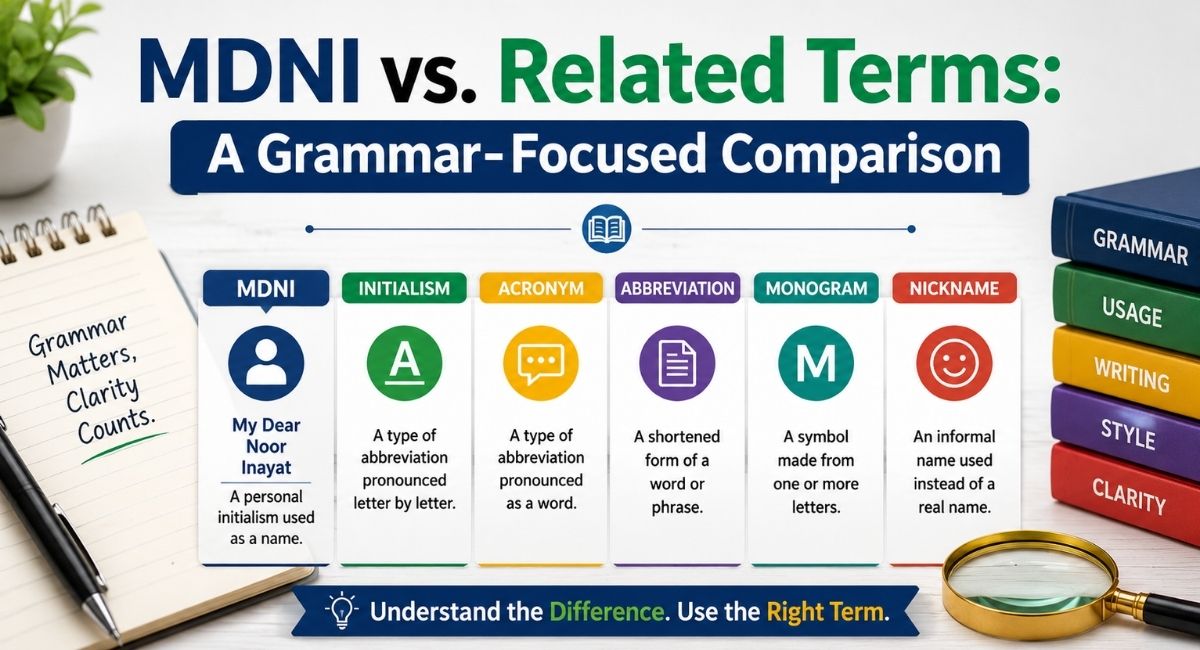
MDNI vs. Related Terms: A Grammar-Focused Comparison
| Term | Full Form | Part of Speech | What It Actually Restricts |
| MDNI | Minors Do Not Interact | Initialism (noun phrase) | Age-based — restricts who can engage |
| DNI | Do Not Interact | Initialism (noun phrase) | Anyone unwanted, not age-specific |
| NSFW | Not Safe For Work | Initialism (adjective phrase) | Content type — warns about material, not audience |
| SFW | Safe For Work | Initialism (adjective phrase) | Confirms content is generally appropriate |
| CW | Content Warning | Initialism (noun phrase) | Flags sensitive topics without restricting audience |
The core distinction to remember: NSFW and CW describe what the content is. MDNI and DNI describe who is welcome. They’re grammatically similar (all initialisms functioning as noun or adjective phrases) but semantically doing completely different jobs.
For Parents and Guardians: What to Actually Do
If you’re here because you found MDNI in your child’s search history or on an account they follow, here’s the practical, non-alarmist version:
- It’s a warning, not a threat. MDNI means the account owner is trying to keep minors out — it’s a protective signal, even though it’s aimed at adult content.
- Check platform reporting tools. Most platforms (TikTok, X, Discord) have built-in reporting for accounts violating age-based access, separate from the MDNI notice itself.
- Talk about why the boundary exists, rather than only removing access — kids encounter these labels across many platforms, and understanding why they matter tends to stick better than a one-time block.
- Use platform-level parental controls as the actual enforcement layer — MDNI itself is only a stated preference, not a technical barrier.
Is MDNI Legally Binding?
No. MDNI is a stated social preference, not a contract or law. Nobody gets legally penalized purely for ignoring an MDNI notice. What does carry weight are the platform’s own Terms of Service around minors and adult content — MDNI simply echoes and reinforces rules that already exist independently of the notice itself.
Frequently Asked Questions
What does MDNI mean?
MDNI stands for “Minors Do Not Interact.” It’s a notice telling anyone under 18 not to follow, comment, or message the account.
Is MDNI an acronym or an initialism?
It’s an initialism — you pronounce each letter individually (M-D-N-I), not as a blended word like an acronym.
How do you pronounce MDNI?
Say each letter separately: “em-dee-en-eye.” There’s no alternate or shortened pronunciation.
Is MDNI the same as NSFW?
No. NSFW describes the content itself (explicit or graphic material), while MDNI describes who is allowed to engage (adults only, age-based).
Is MDNI legally enforceable?
No, not on its own. It’s a stated preference, though separate platform policies about minors accessing adult content are independently enforceable.
Should MDNI always be written in capital letters?
Formally, yes — MDNI is capitalized as an initialism. Lowercase (“mdni”) appears often in casual captions but isn’t the grammatically standard form.