POV Meaning Explained: You open TikTok. A video starts with white text: “POV: You just found out your best friend is moving away.”
Then it’s just someone’s face. Sad music plays.
Wait — that’s not your point of view. That’s their face, their room, their story. So why does everyone keep writing “POV” like this?
If this has confused you, you’re not alone. POV is one of those short forms that everyone uses but almost nobody explains properly — including how to spell it out, punctuate it, or use it in a proper sentence.
This guide breaks it down completely: what POV actually stands for, how to pronounce it, when to capitalize it, and the grammar mistakes people make with it every single day.
What Does POV Mean?
QUICK ANSWER: POV is an initialism that stands for “Point Of View.” It refers to a person’s perspective — how they see, experience, or feel about a situation. On social media, “POV:” is used to introduce a scenario the viewer is meant to imagine themselves in.
POV is not a slang word invented on the internet. It’s a genuine English abbreviation that existed in writing, film, and photography long before TikTok picked it up.
Full form: Point Of View Part of speech: Noun (used as an initialism/abbreviation) Category: Internet slang + formal English term (dual usage)
Here’s the simple breakdown:
- P — Point
- O — Of
- V — View
When you put it together, it literally means “the way someone sees or experiences something.”
How Do You Pronounce “POV”?
This is where a lot of people trip up, especially non-native English speakers.
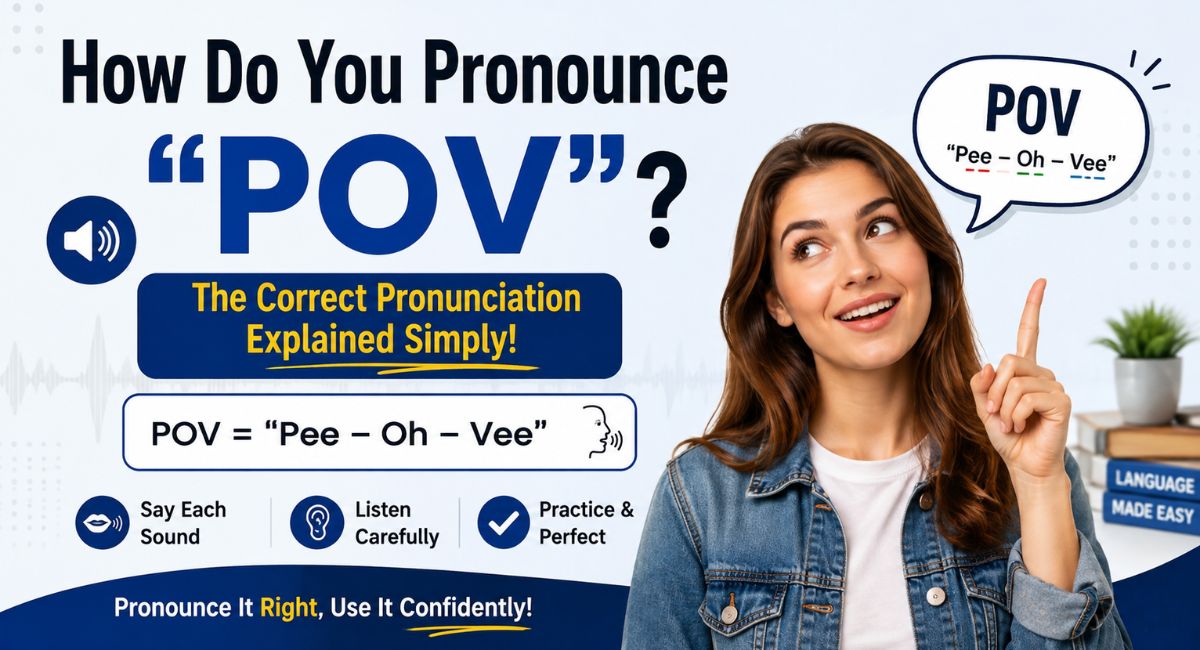
POV is pronounced letter by letter: “P-O-V” (pee-oh-vee).
You do not say it as one word like “pov” rhyming with “cove.” It’s always read as three separate letters, similar to how you’d say CEO or ASAP.
| Written As | Correct Pronunciation | Incorrect Pronunciation |
| POV | P-O-V (pee-oh-vee) | “pov” (rhyming with “cove”) |
| Example | “That’s such a P-O-V moment” | ~~”That’s such a pahv moment”~~ |
This matters because in spoken conversation, saying it wrong instantly signals that someone doesn’t know the term — which is exactly the kind of small grammar detail this guide exists to fix.
Capitalization Rules: POV vs Pov vs pov
Grammatically, this is where most slang guides skip the details. Here’s the actual rule:
- POV (all caps) — This is the standard, grammatically correct form. Since it’s an initialism (each letter representing a full word), it should always be capitalized, just like NASA, ASAP, or FYI.
- Pov (capital P only) — Incorrect in formal writing. Sometimes seen in casual texting, but it doesn’t follow standard initialism rules.
- pov (lowercase) — Acceptable only in extremely casual texting or captions where the whole message is in lowercase style. Not correct in formal or academic writing.
Rule of thumb: If you’re writing an essay, email, or professional caption, always use POV in full capitals. If you’re texting casually, lowercase is stylistically fine — but know that it’s a style choice, not a grammar rule.
Origin and History of “POV”
POV didn’t start on TikTok. It has a much older home in filmmaking, photography, and literature.
In filmmaking: A “POV shot” is a camera technique where the audience sees exactly what a character sees — through their eyes. Horror movies use this constantly to make you feel like you’re the one being chased.
In literature: “First-person POV” means the narrator refers to themselves as “I,” and the reader experiences the story through that character’s thoughts.
In photography: POV cameras (like GoPros) are literally named for this — they capture footage from the wearer’s exact viewpoint.
The internet picked up this existing term in the early 2010s for gaming and YouTube “POV playthroughs,” where the meaning stayed literal — you were watching through someone’s actual eyes.
Then TikTok arrived around 2019–2020. Short-form video needed instant context. Creators started typing “POV:” as a caption to set up a scenario in seconds. Holding the camera to show a literal first-person view felt clunky for skits, so creators just faced the camera and acted out the scene instead.
The literal meaning loosened. By 2021, “POV” had shifted from “here’s exactly what you’d see” to “here’s a situation — imagine you’re in it.”
Narrative POV Types (The Grammar Behind the Term)
Since POV is rooted in real English grammar, it’s worth knowing the three narrative perspectives it originally described. This is useful for writing, school assignments, and understanding why the term carries weight beyond slang.
| POV Type | Pronoun Used | Example |
| First-person POV | I, me, we | “I walked into the room and froze.” |
| Second-person POV | You | “You walk into the room and freeze.” |
| Third-person POV | He, she, they | “She walked into the room and froze.” |
Interestingly, TikTok’s “POV:” format almost always uses second-person grammar — even though it’s shown through the creator’s own face. That’s why captions read “POV: You’re the friend who cancels plans,” not “POV: I’m the friend who cancels plans.” The grammar puts you, the viewer, into the story.
How “POV” Is Used on Different Platforms
TikTok
The birthplace of modern POV content. Creators act out a character while the caption places you inside the scenario.
Example: “POV: Your toxic ex texts you after three months of silence.”
Used in Reels and photo captions to add narrative context.
Example: “POV: You finally quit your job and booked the flight.”
Twitter/X
Mostly text-based, often sarcastic or observational, without video.
Example: “POV: You’re a recruiter asking for 10 years of experience for an entry-level role.”
Snapchat
Casual, personal Stories content.
Example: “POV: It’s Sunday night and you haven’t started your homework.”
Texting
Used between friends to describe a relatable moment quickly.
Example: “POV: I’m pretending to work while watching the clock.”
| Platform | Common Use | Typical Tone |
| TikTok | Skits, emotional storytelling | Dramatic or comedic |
| Reels, captions | Relatable, aspirational | |
| Twitter/X | Text-based jokes | Sarcastic, observational |
| Snapchat | Personal Stories | Casual, friendly |
| Texting | Quick relatable moments | Informal |
Common Grammar Mistakes People Make With “POV”
Since this term blends formal grammar with internet slang, mistakes are common. Here are the most frequent ones:
- Wrong punctuation after POV
- ❌ “POV, you’re late for work”
- ✅ “POV: You’re late for work” (a colon is standard, not a comma)
- Mixing pronoun perspective mid-sentence
- ❌ “POV: I’m running late and you can’t find your keys”
- ✅ “POV: You’re running late and can’t find your keys” (stay consistent in second-person)
- Treating POV as a verb
- ❌ “I’m going to POV this situation”
- ✅ POV is a noun/initialism, not an action word — it can’t be “done”
- Inconsistent capitalization in formal writing
- ❌ “The Pov shot was effective” (in an essay)
- ✅ “The POV shot was effective”
- Confusing POV with “point of you”
- This is a genuine spelling mistake some learners make. It’s “point of view,” not “point of you.” There’s no “you” in the phrase at all.
Examples of “POV” in Sentences
Casual/Everyday
- “POV: You’re the one who has to explain the group chat drama.”
- “POV: It’s 4:59 PM on Friday and your boss just messaged you.”
Formal/Academic
- “The novel is written entirely from the protagonist’s POV.”
- “Switching POV mid-chapter can confuse readers if not done carefully.”
Sarcastic
- “POV: You’re the WiFi router when the whole family is home.”
Romantic
- “POV: Your crush finally texts back within five minutes.”
Variations and Related Terms
POV doesn’t have real spelling variations — “POV,” “P.O.V.,” and “pov” all mean the same thing, just with different formatting.
Related terms that serve a similar storytelling function:
| Term | Meaning | How It Differs From POV |
| TFW | That Feeling When | Sets up an emotion, not a full scenario |
| Me when | Personal relatable reaction | Speaker-focused, not viewer-focused |
| IYKYK | If You Know, You Know | Insider reference, no scenario built |
| FPS (gaming) | First Person Shooter | Uses POV literally — game seen through character’s eyes |
Is “POV” Appropriate to Use Anywhere?
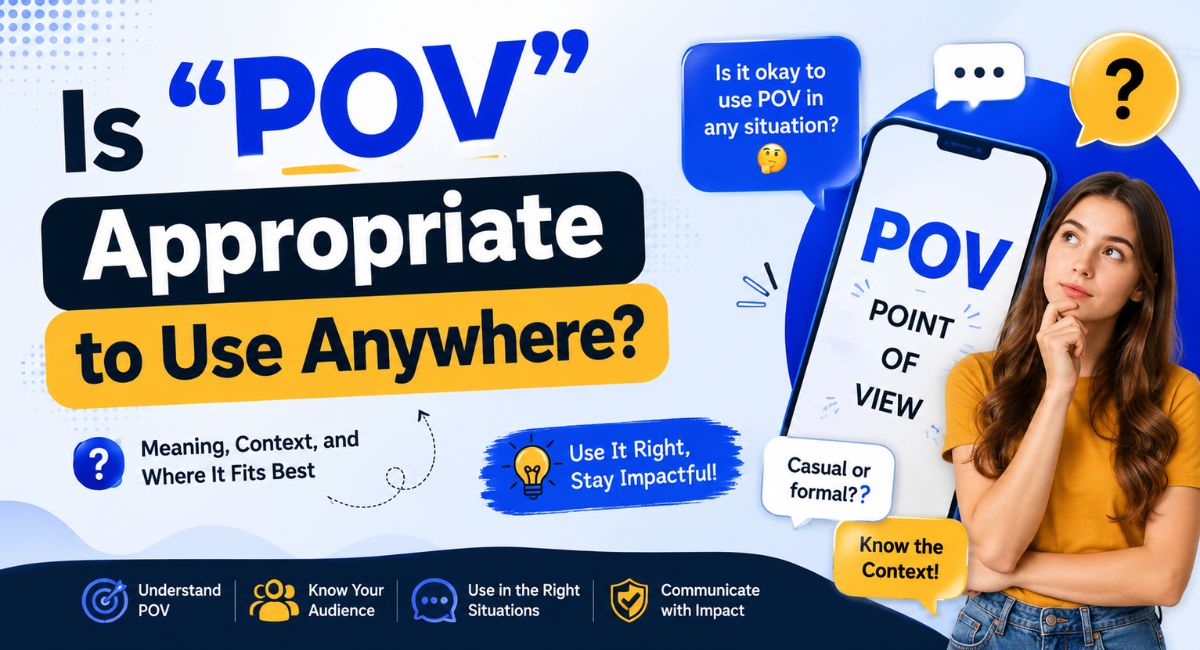
Short answer: Yes, in casual and creative writing. Use caution in formal writing.
Safe to use in:
- Texts, captions, and social media posts
- Creative writing and storytelling exercises
- Casual conversation about content or media
Avoid or spell out in:
- Formal emails or academic essays (write “point of view” in full)
- Professional presentations
- Legal or technical documents
POV Meaning Explained: Conclusion
POV stands for “Point Of View” — a term with real grammatical roots in literature and film, not just a TikTok invention. Understanding its full form, correct capitalization, and proper punctuation helps you use it confidently in both casual chats and formal writing.
The internet didn’t break the meaning of POV — it just added a creative, second-person storytelling layer on top of a term that’s been around for decades.
Next time you see “POV:” on your feed, you’ll know exactly what it stands for, how to say it out loud, and how to use it correctly yourself.
FAQ
Q1: What does POV stand for? POV stands for “Point Of View.” It refers to a person’s perspective or the way they see and experience a situation.
Q2: How do you pronounce POV? POV is pronounced letter by letter as “P-O-V” (pee-oh-vee), not as a single word.
Q3: Should POV always be capitalized? Yes, in formal writing POV should always be in capital letters since it’s an initialism. Lowercase “pov” is only acceptable in casual texting.
Q4: What’s the difference between POV and “me when”? POV uses second-person grammar to place the viewer inside a scenario (“POV: You’re late”), while “me when” describes the speaker’s own reaction in first person.
Q5: Is it correct to say “point of you” instead of “point of view”? No, this is a common spelling mistake. The correct phrase is “point of view” — there is no “you” in the term at all.