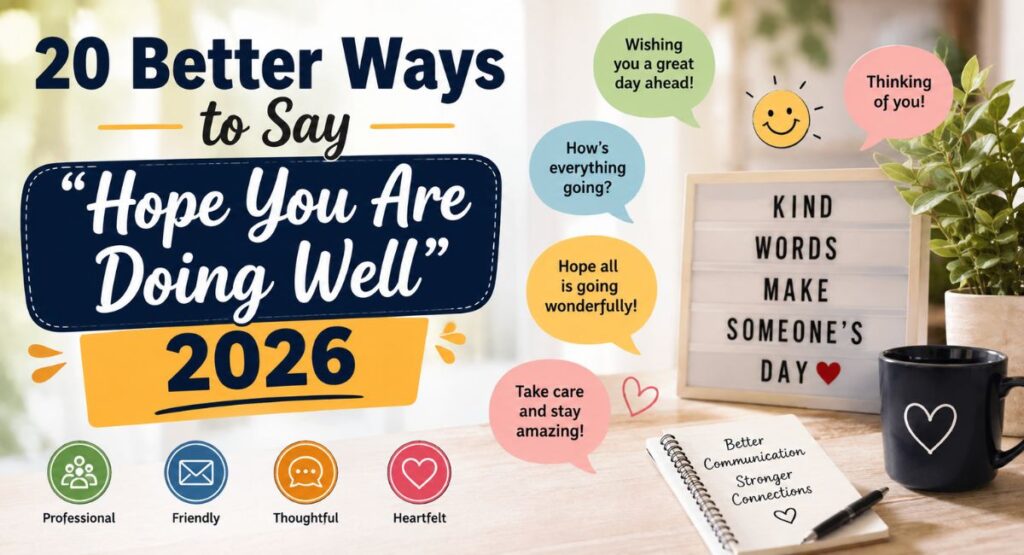
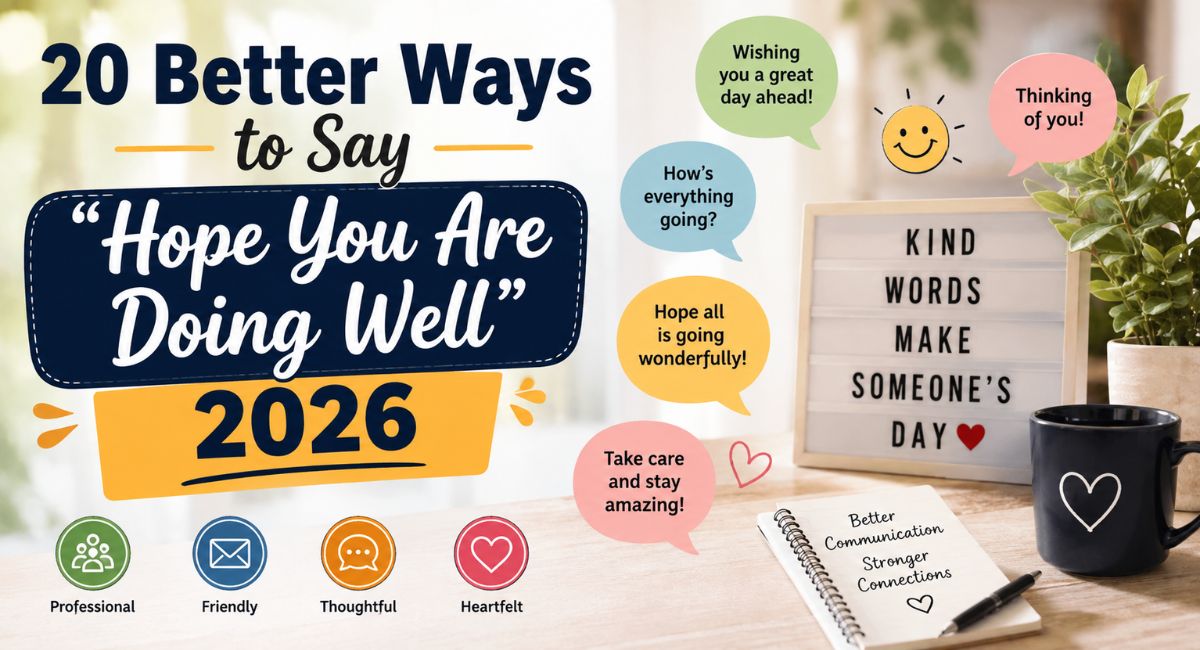
Opening an email with “hope you are doing well“ is standard practice in professional communication. However, overusing this phrase can make your messages feel generic, automated, or repetitive.
Understanding the exact meaning, proper grammar, and fresh alternatives to this phrase will make your emails clear, polished, and polite.
Featured Snippet: Quick Meaning & Grammar Summary
- What does it mean? “Hope you are doing well” is a courteous email opener used to express good wishes for the recipient’s health, happiness, or general situation before diving into the main topic.
- Is it grammatically correct? Yes. It is a shortened form of the full sentence “I hope [that] you are doing well.” Omitting the pronoun “I” is acceptable in informal and semi-formal writing.
- Should you use “doing well” or “doing good”? Use “doing well.” “Well” is an adverb describing the action verb “doing.” “Good” is an adjective. Say “I hope you are doing well” rather than “doing good.”
The Grammar Behind “Hope You Are Doing Well”
Many writers struggle with whether this opening line is grammatically sound. Here is a breakdown of why it works and where common grammar mistakes occur.
1. Ellipsis: The Dropped “I”
In everyday English, writers frequently drop the subject pronoun “I” at the start of a sentence. This linguistic shorthand is called an ellipsis.
- Full Formal Structure: “I hope that you are doing well.”
- Conversational Structure: “Hope you are doing well.”
Both versions are grammatically valid. Use the full sentence for formal correspondence (such as job applications) and the shortened version for regular workplace check-ins.
2. “Doing Well” vs. “Doing Good”
Mixing up “well” and “good” is one of the most frequent grammar mistakes in email greetings.
- Doing well: Refers to health, state of being, or progress (“well” modifies the verb doing).
- Doing good: Refers to performing charitable or righteous deeds (e.g., “She is doing good work in the community”).
To wish someone good health and smooth operations, always write “doing well.”

Why You Should Consider Alternatives
While “hope you are doing well” is polite, relying on it for every email creates three main issues:
- Email Fatigue: Readers process dozens of emails daily starting with the exact same sentence, causing them to skip past your intro.
- Lack of Personalization: Generic greetings can make cold emails or follow-ups feel like automated templates.
- Context Mismatch: If the recipient is facing a known deadline, crisis, or major change, a generic “hope you’re well” can sound out of touch.
20 Professional Alternatives to “Hope You Are Doing Well”
Choosing the right phrase depends on your relationship with the recipient and the tone you want to set.
Professional & Formal Alternatives
Use these when emailing clients, executives, or contacts you do not know well.
- “I hope this message finds you well.”Best for: First-time outreach, formal inquiries, or corporate clients.
- “I trust you are having a productive week.”Best for: Mid-week business follow-ups and project updates.
- “It is a pleasure connecting with you again.”Best for: Re-engaging past clients or colleagues after an interval.
- “I hope all is going according to plan on your end.”Best for: Checking in on ongoing projects or joint initiatives.
- “I hope your week is off to a great start.”Best for: Monday morning communications.
Friendly & Semi-Formal Alternatives
Ideal for regular coworkers, project collaborators, and established business contacts.
- “I hope you’re having a good week.”Best for: Standard internal team emails.
- “How are things progressing with [Project Name]?”Best for: Direct, action-oriented project check-ins.
- “I hope you had a restful weekend.”Best for: Monday or Tuesday follow-ups.
- “Hope things are going smoothly on your side.”Best for: Peer-to-peer updates.
- “Congratulations on [Recent Milestone]!”Best for: Warm outreach referencing a promotion, launch, or award.
Casual & Warm Alternatives
Best suited for close colleagues, friends, or informal team chats.
- “How are you doing?”Best for: Simple, direct, and conversational check-ins.
- “Hope life is treating you well!”Best for: Casual updates to people you haven’t spoken to in a while.
- “Hope you’re staying safe and healthy.”Best for: Showing thoughtful care during busy or challenging periods.
- “What’s the latest in your world?”Best for: Informal catch-ups with close peers.
- “Hope you’re having a smooth day so far.”Best for: Quick midday messages.
Direct & Action-Oriented Alternatives (No Greeting Needed)
Sometimes the best opener skips the pleasantry altogether to respect the recipient’s time.
- “I’m reaching out regarding…”Best for: Urgent requests or quick administrative tasks.
- “Quick question about [Topic]:”Best for: Short, focused queries.
- “Following up on our conversation from [Day]:”Best for: Ongoing threads and meeting action items.
- “I wanted to share a quick update on [Task]:”Best for: Status reports.
- “Hope you’re enjoying the [Season/Weather]!”Best for: Casual, timely rapport building.
Quick Reference: Matching Greeting to Context
| Context / Tone | Best Phrase Option | Avoid Using |
| Formal / First Outreach | “I hope this email finds you well.” | “What’s up?” / Overly familiar lines |
| Mid-Week Follow-Up | “I hope you’re having a productive week.” | Generic Monday greetings |
| Close Colleague | “How are you doing?” or “Hope you’re having a good day.” | Rigid, overly formal phrasing |
| Urgent Request | Jump straight to the point: “I’m reaching out to…” | Long filler pleasantries |
Frequently Asked Questions (FAQ)
Is it polite to say “I hope you are doing well”?
Yes, it is a universally recognized polite greeting in written English. It demonstrates basic courtesy before stating the reason for your message.
What is the difference between “Hope you are doing well” and “Hope all is well”?
Both phrases convey the exact same meaning. “Hope all is well” is simply shorter and slightly more versatile, as it encompasses the recipient’s overall situation (work, family, life) rather than just their personal actions.
How do you reply to “Hope you are doing well”?
You can respond briefly before addressing the main topic. Common replies include:
- “Thanks! I’m doing well, hope you are too.”
- “Thank you, hope you’re having a great week as well.”
- “Doing well, thanks for asking!”
Is “I hope this email finds you well” better?
“I hope this email finds you well” is more formal. It works better for professional first contacts, while “hope you are doing well” is better suited for contacts with whom you already have an established relationship.