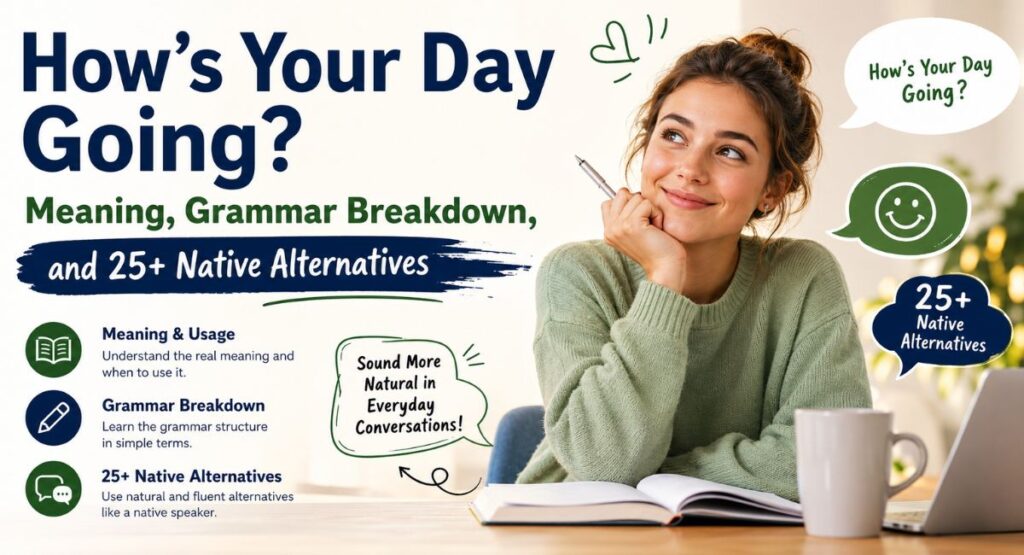
Have you ever had someone ask, “How’s your day going?” and hesitated for a second before answering? Whether you are learning English, working on your daily grammar, or simply trying to avoid giving the same boring reply every single time, this common greeting can feel surprisingly tricky.
While it sounds like a simple question, knowing when to use it, how it differs from similar phrases, and how to respond naturally will make your everyday conversations much smoother.
In this guide, you will learn the exact grammar mechanics behind the phrase, the best ways to respond in any situation, and better alternatives to sound like a native English speaker.
What Does “How’s Your Day Going?” Mean?
“How’s your day going?” is a friendly, low-pressure question used to check in on someone’s progress, mood, or activities during the current day.
It acts as a social bridge—a warm greeting that invites a light conversation without demanding a deep personal explanation.
Quick Definition: The phrase asks about your current experience between the start of your day and the exact moment you are being asked.

Grammar Breakdown: Is “How’s Your Day Going?” Correct?
Yes, “How’s your day going?” is 100% grammatically correct.
Because English contractions and tenses can be confusing, breaking down the exact grammar behind this sentence clarifies how it functions:
1. The Contraction (How’s)
- How’s is a contraction for “How is”.
- Example: “How is your day going?”
- Common Mistake: Do not confuse “How’s” (How is) with “House.” Always include the apostrophe between w and s to show the shortened verb.
2. The Present Continuous Tense (is going)
- The phrase uses the present continuous tense (is + verb-ing).
- This shows that the day is still happening in real time and is not finished yet.
3. “Going” vs. “Been” vs. “Gone”
Choosing the correct form depends on the time of day:
| Phrase | Verb Tense | When to Use | Example Context |
| “How’s your day going?” | Present Continuous | Middle of the day (morning to late afternoon) | Chatting with a colleague at lunch. |
| “How has your day been?” | Present Perfect | Late afternoon or evening when the main day is wrapping up | Calling a friend after work hours. |
| “How did your day go?” | Simple Past | End of the day or the following day | Talking to family over dinner. |
Better Alternatives to “How’s Your Day Going?”
Depending on whether you are writing a business email, texting a friend, or talking to a romantic partner, using the exact same phrase can get repetitive.
Here are the best native alternatives organized by tone and context:
Professional & Workplace Alternatives
Use these when speaking with managers, clients, or colleagues in formal settings:
- “How has your week been treating you?” (Polite and respectful)
- “I hope your day is off to a productive start.” (Great opening line for emails)
- “How are things progressing on your side today?” (Work-focused without feeling intense)
- “How is your afternoon shaping up?” (Ideal for mid-day check-ins)
Casual & Everyday Alternatives
Perfect for friends, neighbors, or acquaintances:
- “How’s it going today?” (Classic, relaxed, and extremely common)
- “What have you been up to today?” (Encourages a quick story)
- “Anything exciting happen so far?” (Focuses on positive highlights)
- “How’s your morning treating you?” (Friendly and conversational)
Texting, Social Media & Flirting
When sending a quick DM or text message, keep things short and playful:
- “Surviving the day so far?” (Playful and highly relatable)
- “What’s today’s headline?” (Fun way to ask for highlights)
- “Pretty good now that you messaged.” (Flirty and sweet)
- “How’s your energy holding up today?” (Caring and informal)
How to Respond to “How’s Your Day Going?”
Your reply depends on your mood and who is asking. Here is a helpful list of natural responses:
1. Positive & Enthusiastic Responses
- “It’s going great, thanks for asking! How about yours?”
- “Pretty good so far! Just got through my morning meetings.”
- “Can’t complain! Hope you’re having a good one too.”
2. Neutral & Quick Responses
- “Going well, keeping busy! How are things with you?”
- “Not bad at all, just taking it step by step.”
- “So far, so good! How’s your day looking?”
3. Polite Responses When Having a Rough Day
You don’t always have to fake a perfect day, but you can keep it polite:
- “A bit chaotic, but hanging in there! How are you?”
- “It’s been a busy one, but looking forward to the evening.”
- “A little stressful, to be honest, but making progress.”
Frequently Asked Questions
Is “How’s your day going?” formal or informal?
It falls right in the middle. It is casual enough for friends and family, but polite and respectful enough for most workplace conversations and professional emails.
What is the difference between “How are you?” and “How’s your day going?”
“How are you?” asks about a person’s general physical or emotional state. “How’s your day going?” specifically asks about the events and experiences happening during that specific day.
Should I answer with “I’m good” or “It’s good”?
Both are common in spoken English! However, because the question asks about your day, replying “It’s going well” or “It’s been good” is more grammatically precise.
To hear these natural expressions in everyday spoken English and refine your conversational flow, check out this guide on alternatives to standard English greetings. Seeing how native speakers adjust their tone in real time will help build your confidence in any setting!