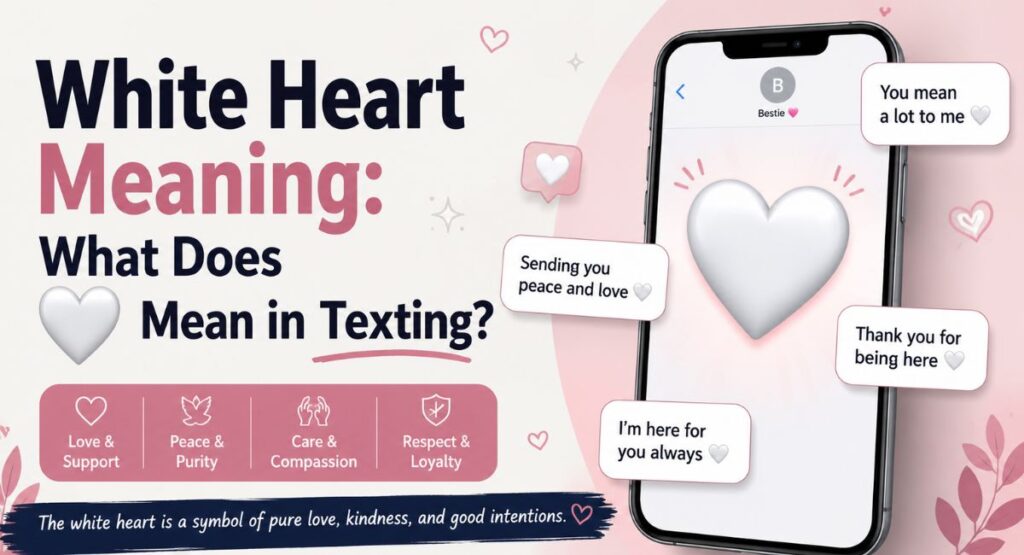
White Heart Meaning: The white heart emoji (🤍) typically represents pure, platonic, or unconditional love, but it’s also widely used to express condolences and mourning, and in Japan and South Korea it’s tied to White Day (March 14), a reciprocal gift-giving holiday. Unlike the red heart, its meaning depends heavily on the surrounding context.
Why People Pause Before Sending a White Heart
Most heart emojis have one dominant meaning — red means romantic love, green means environmentalism or St. Patrick’s Day, purple often signals fandom or the military honor. White is different. It sits in a genuinely ambiguous space between “I love you purely,” “I’m so sorry for your loss,” and “happy White Day,” and the same emoji can carry all three depending entirely on the conversation it appears in.
That ambiguity is exactly why people hesitate before sending it, and why this guide exists: not just to define it, but to walk through the specific contexts where the meaning shifts, and the small formatting habits (capitalization, placement, pairing) that signal which one you actually mean.
What Part of Speech Is an Emoji Like 🤍?
A quick grammar note before the meanings, because it changes how you should punctuate around it.
- Emojis function like interjections or tone markers, not like words with a fixed grammatical role. They typically sit at the end of a sentence, functioning similarly to an exclamation point or a closing gesture.
- Punctuation placement: a period or exclamation mark can go either before or after the emoji depending on style, but placing punctuation directly before the emoji (“I love you. 🤍”) tends to read more deliberate than tacking the emoji on with no space (“I love you.🤍”).
- Capitalization in writing about it: when referring to the emoji by name in text, “white heart” is lowercase as a common noun (“she sent a white heart”), while “White Day” (the Japanese and Korean holiday) is capitalized as a proper noun.
- Repetition changes tone: one white heart (🤍) reads calm and sincere; three or more (🤍🤍🤍) tend to intensify the emotion, common in messages of grief or strong affection alike — context still does the heavy lifting either way.
The Core Meanings of a White Heart
1. Pure, Platonic, or Unconditional Love
This is the most common everyday use — a white heart signals love that isn’t necessarily romantic, or romantic love framed as especially sincere and uncomplicated. It’s a common choice between close friends, family members, or new couples who want to signal something gentler than a red heart.
2. Grief, Condolences, and Mourning
Because of its muted, non-flashy color, a white heart is a frequent choice in posts and messages about loss — tribute posts, memorial captions, and messages of condolence often use it instead of a red heart, which can feel too celebratory for the moment. It’s often paired with a dove (🕊️) or a blue heart (💙) in these contexts.
3. White Day (Japan and South Korea)
In Japan and South Korea, White Day falls on March 14, exactly one month after Valentine’s Day, and is a holiday where people who received gifts on Valentine’s Day give a reciprocal gift back — traditionally white-colored items like white chocolate. A white heart emoji around mid-March, especially alongside a chocolate emoji (🍫), is very likely referencing this holiday rather than a general “pure love” sentiment.
4. A Simple Aesthetic Choice
Not every white heart carries deep meaning. On social media, especially in minimalist or monochrome-themed posts, a white heart is sometimes used purely because it fits the visual palette of the photo or profile — a reminder that context still overrides any single “official” definition.
Real Chat Examples
Text between close friends “You’ve been there for me through everything this year 🤍 genuinely don’t know what I’d do without you”
Instagram caption on a tribute post “One year today. Miss you every single day. 🤍🕊️”
Message in mid-March “Got you something for White Day 🤍🍫 open it when you get home!”
The emoji is identical in all three, but the surrounding words — “there for me,” “miss you,” “White Day” — are what actually carry the meaning. Strip the caption away and the emoji alone tells you almost nothing.
Comparison Table: White Heart vs. Other Common Hearts
| Emoji | Primary Meaning | Common Context | Formality |
| 🤍 White Heart | Pure/platonic love, grief, White Day | Friendship, condolences, mid-March gifting | Sincere, understated |
| ❤️ Red Heart | Romantic love, strong affection | Everyday romantic or enthusiastic messages | Warm, expressive |
| 🖤 Black Heart | Dark humor, edgy aesthetic, sometimes grief | Casual, ironic, or gothic-aesthetic posts | Casual to ambiguous |
| 💙 Blue Heart | Calm, loyal, platonic support; paired with white for grief | Support messages, fandom colors | Neutral to supportive |
| 💜 Purple Heart | Fandom (especially K-pop), military honor | Fan messages, tribute to service members | Context-dependent |
Common Mistakes People Make With the White Heart Emoji
- Assuming it always means romance. Because it looks like a paler red heart, people sometimes read it as automatically romantic — but in most non-romantic contexts (friendship, condolences), that assumption misses the intended tone entirely.
- Sending it in a grieving context without any accompanying words. A bare white heart with zero text under a sensitive post can come across as detached; pairing it with even a short message makes the intent clearer.
- Confusing it with “White Day” outside of March. The holiday-specific meaning only really applies around mid-March; using it that way in July will likely just read as general affection instead.
- Overloading a message with multiple heart colors. Stacking white, red, and purple hearts together in one casual message can muddy the tone — picking one that matches the actual context usually communicates more clearly.
Related Reads
White Heart Meaning: FAQs
What does a white heart emoji mean from a friend? It typically signals pure, platonic love or appreciation — a gentler, less romantically loaded alternative to a red heart.
Does a white heart mean someone passed away? Not on its own, but it’s commonly used in condolence messages and tribute posts because its muted tone fits grief better than a bright red heart. The surrounding words usually confirm the context.
What is White Day, and how does it relate to the white heart emoji? White Day is a holiday observed on March 14 in Japan and South Korea, where people reciprocate Valentine’s Day gifts, often with white-colored items. A white heart emoji used around that date is often referencing the holiday specifically.
Is a white heart romantic or platonic? It can be either — the emoji itself doesn’t specify, so the surrounding message and relationship context determine whether it reads as romantic or platonic.