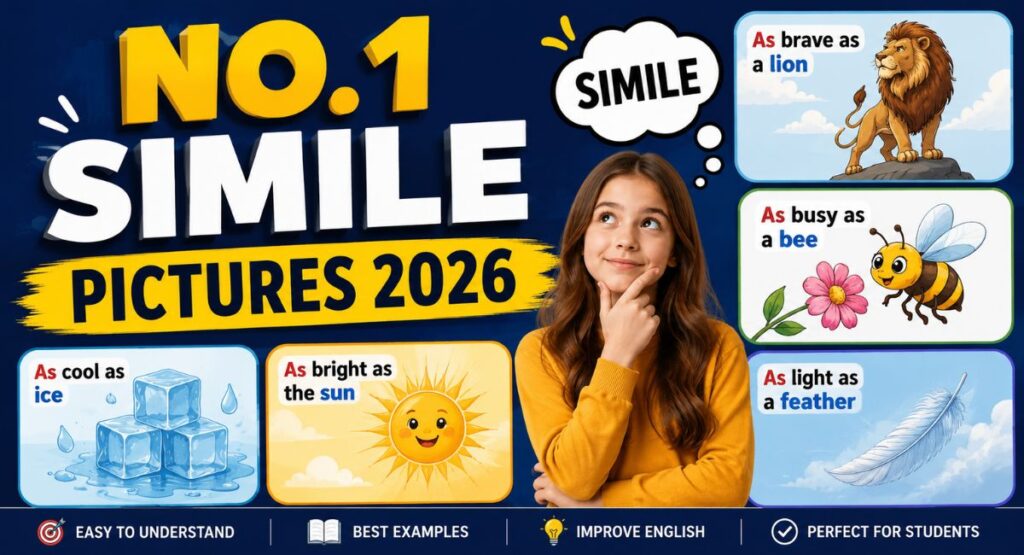
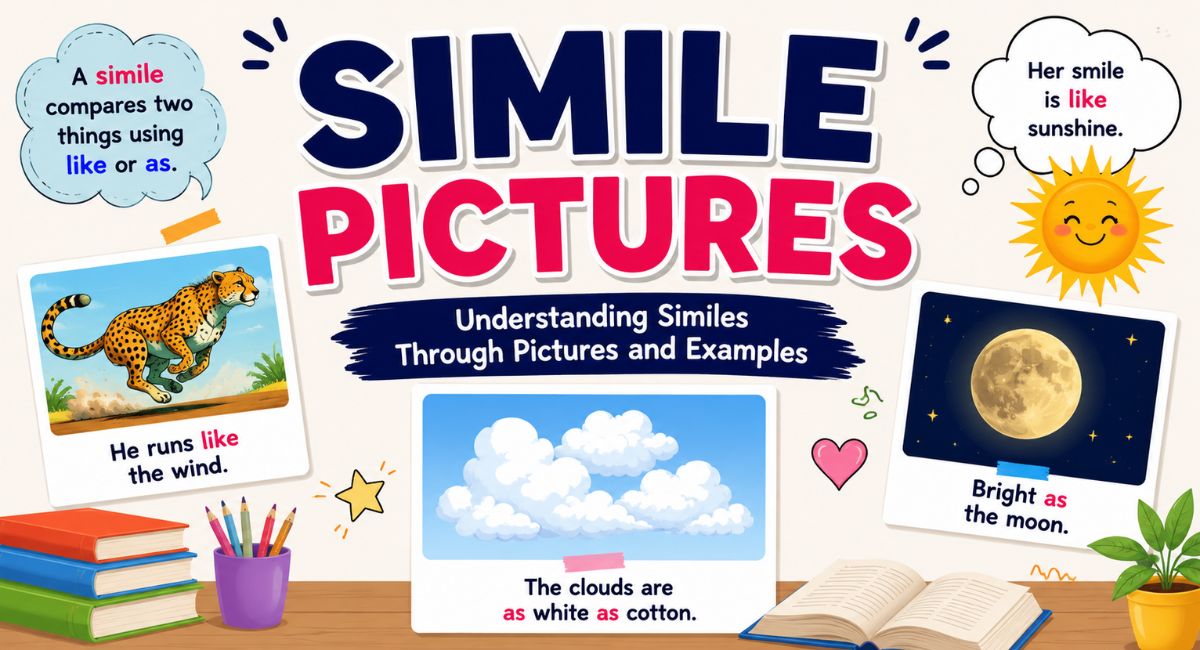
Simile pictures: Have you ever tried explaining a complex feeling or an abstract concept, only to realize words alone are failing you? That is exactly where similes step in. A simile is a figure of speech that compares two different things using the words “like” or “as”* (e.g., “as cool as a cucumber” or “crying like a baby”).
But in a digital-first world dominated by memes, short-form video, and visual storytelling, text alone doesn’t cut it anymore. We need simile pictures—visual representations that instantly connect the dots between the literal and the metaphorical.
Whether you are looking to elevate your social media captions, design an engaging infographic, or simply understand how visual metaphors dominate internet culture, this guide cuts through the standard dictionary fluff to give you highly actionable, modern visual examples.
Why Our Brains Crave Simile Pictures
Standard language sites love to list out generic cliches like “as brave as a lion.” But why do visual representations matter so much to digital natives and tech-savvy creators?
- Instant Pattern Recognition: The human brain processes images 60,000 times faster than text. Seeing an illustration of a simile triggers immediate emotional resonance.
- Deconstructive Learning: If you’re teaching, creating content, or designing UI, an explicit side-by-side visual of a comparison builds stronger cognitive associations.
- Memetic Value: The best memes on TikTok or X are essentially hyper-modern visual similes. When a creator overlays text saying “Me trying to handle adult responsibilities like…” over a chaotic video of a broken object, they are using visual figurative language.
Classic vs. Modern Similes: A Side-by-Side Breakdown
To give you immediate “information gain”—the practical value that basic grammar blogs leave out—let’s look at how everyday expressions map out visually versus how we use them today online.
| Traditional Simile | Visual Concept | Modern Internet Equivalent (Gen Z / Tech Context) |
| As busy as a bee | A swarming beehive or a cartoon bee rushing with honey. | “Running around like a laptop with 47 chrome tabs open.” |
| As clear as crystal | A perfectly transparent, flawless gemstone. | “As clear as a 4K OLED display streaming at 60fps.” |
| Like a fish out of water | A fish gasping on a dry boat dock. | “Like trying to navigate a new app UI after a terrible update.” |
| As slow as a snail | A small garden snail leaving a trail on a leaf. | “Loading like 2G data in a crowded stadium.” |
Frequently Asked Questions
Many basic educational websites give you a lazy list of 10 sentences and call it a day. They completely miss how visual language functions in the wild. Let’s tackle the real questions creators and internet users are asking:
What is the difference between a visual simile and a visual metaphor?
This trips up almost everyone. A visual simile explicitly shows both elements being compared side-by-side or clearly links them with an obvious bridge (like a split-screen image showing a messy room next to a literal dumpster fire). A visual metaphor completely replaces the subject with the image—merging them into one cohesive concept without an explicit bridge.
How can I use simile pictures to improve my social media engagement?
Instead of writing a boring text update about being tired, use a high-contrast image that serves as a simile. Pairing an image of a completely depleted, corroded smartphone battery with the caption “Woke up feeling like…” relies on the visual simile format. It creates instant relatability, driving higher share rates and comment interactions.
Are emojis considered simile pictures?
Absolutely! Emojis are the shorthand infrastructure of modern visual language. When you text someone “I’m sweating like 🥵” or “They have a heart of 🧊”, you are using graphic icons to actively construct similes in real-time digital dialogue.
Level Up Your Visual Content
Understanding figurative language isn’t just for grade-school English classes—it’s the secret sauce behind viral marketing, clean web design, and compelling communication. The next time you create content, don’t just state a fact. Find a sharp, modern visual comparison that makes your audience say, “I know exactly what you mean.”