Have you ever stopped to admire a rugged stone fireplace, a sleek brick accent wall, or even the seamlessly staggered layout of images on your favorite Pinterest board? If so, you’ve experienced the power of masonry.
But if you typed “masonary” into your search bar to get here, you aren’t alone. It is one of the most common spelling tripwires on the internet.
Under recent search quality updates, search engines prioritize genuine utility and deep expertise over generic grammar filler. Below, we break down why this spelling confusion happens, exactly how the physical trade works, and an angle most resources completely ignore: how “masonry” became a pillar of modern web design.
1. The Definitive Verdict: Masonry vs. Masonary
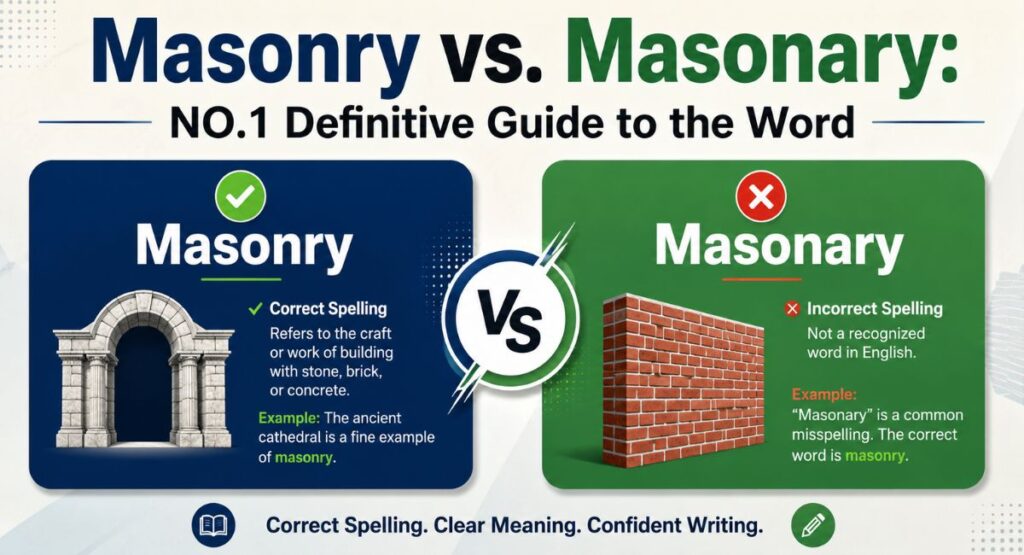
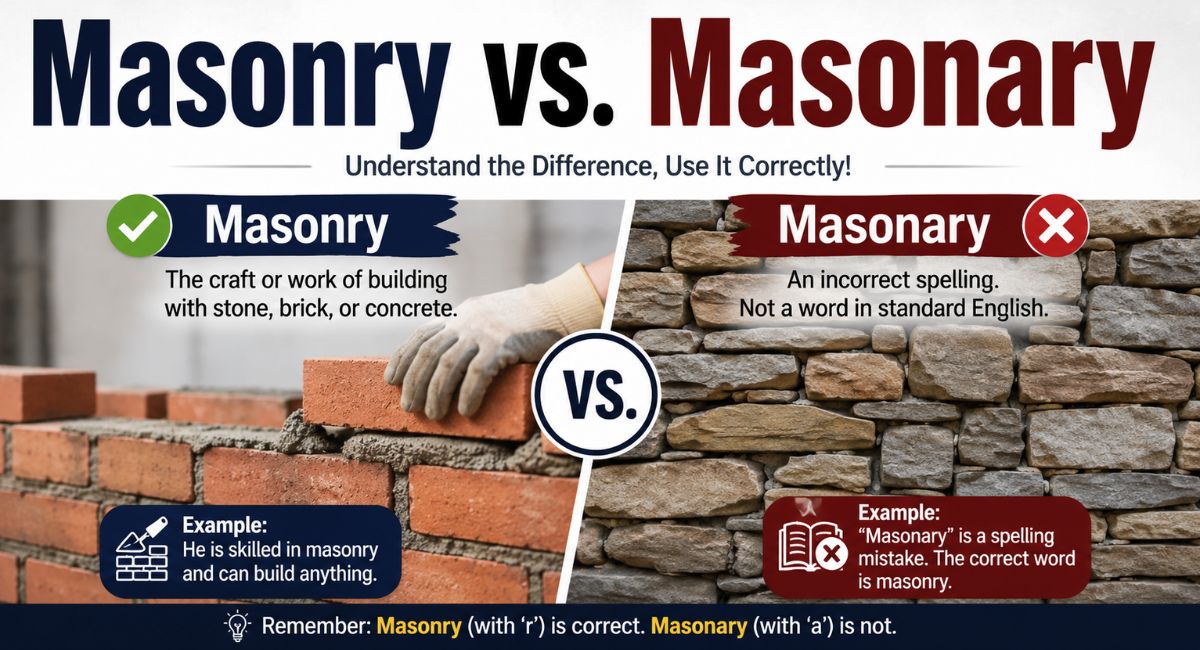
Let’s solve the core linguistic question immediately: “Masonry” is the correct spelling.
“Masonary” (with an extra “a”) is an incorrect phonetic spelling. It does not officially exist in the English language, though it populates millions of search queries monthly.
Why Do So Many People Add the Extra “A”?
The confusion stems entirely from pronunciation. When spoken naturally, the transition between the “on” and the “ry” sounds creates a vocal buffer that sounds like an extra syllable: may-son-uh-ree.
❌ Incorrect: Mas-on-a-ry (May-son-uh-ree)
   Correct:   Mas-on-ry   (May-son-ree)
In the digital world, search engines are smart enough to look past this typo. If you search for “masonary contractors near me” or “CSS masonary layout,” algorithms automatically correct the search intent to point toward standard masonry content. However, using the correct spelling is vital for professional communication, blueprints, contract bidding, and tech documentation.
2. The Physical Craft: Building with Brick, Stone, and Concrete
In the physical world, masonry is one of humankind’s oldest and most durable construction techniques. It refers to the art of building structures by binding individual units together with mortar—a paste made of cement, sand, and water that cures to a stone-like hardness.
Core Types of Physical Masonry
- Brick Masonry: Known for its uniform lines and classic aesthetic. Bricks are highly fire-resistant and structurally dependable for load-bearing walls.
- Stone Masonry: The oldest form of the craft. It uses natural, irregular stones or dressed (shaped) blocks. It is prized for its longevity and organic, high-end look.
- Concrete Block Masonry (CMU): The backbone of modern commercial construction. These hollow blocks are larger than bricks, allowing for rapid, reinforced building.
- Veneer Masonry: A popular contemporary choice where a non-load-bearing layer of thin brick or stone is affixed to a wood or steel frame purely for aesthetic appeal.
3. The Digital Transition: What Is a “Masonry Layout” in Tech?
While traditional guides focus exclusively on cement and trowels, they miss an entire generation of searchers: web developers, designers, and tech-savvy individuals.
In modern UI/UX design, a Masonry Layout is a grid format where elements are arranged in a staggered fashion, optimizing vertical space.
Unlike a standard grid where every row has uniform item heights, a digital masonry layout places items based on available vertical space—much like a traditional bricklayer fits stones of varying sizes into a wall.
Standard Grid Layout (Rigid Rows)     Masonry Grid Layout (Staggered/Fluid)
┌───────────┐ ┌───────────┐          ┌───────────┐ ┌───────────┐
│  Item 1   │ │  Item 2   │          │  Item 1   │ │  Item 2   │
└───────────┘ └───────────┘          │           │ └───────────┘
┌───────────┐ ┌───────────┐          │           │ ┌───────────┐
│  Item 3   │ │  Item 4   │          └───────────┘ │  Item 3   │
│           │ └───────────┘          ┌───────────┐ │           │
└───────────┘                        │  Item 4   │ └───────────┘
                                     └───────────┘
The Best Examples of Digital Masonry
- Pinterest: The quintessential example of a modern masonry interface. Images of varying heights stack vertically without creating awkward whitespace gaps.
- Portfolio Sites: Photographers and graphic artists frequently use fluid masonry grids to showcase diverse aspect ratios without cropping their work.
- E-commerce Dashboards: Visual-first retail sites use dynamic masonry columns to display products seamlessly on responsive mobile interfaces.
Frequently Asked Questions
Does CSS native Grid natively support a masonry layout yet?
Historically, developers relied heavily on JavaScript libraries like Masonry.js or complex Flexbox hacks to achieve the staggered look. However, the CSS Grid Layout Module Level 3 introduces a native grid-template-rows: masonry; property. While browser compatibility is expanding, many production environments still deploy lightweight scripts or alternative CSS workarounds for absolute cross-browser reliability.
How does misspelling “masonry” affect local SEO for businesses?
If you run a contracting business, optimizing solely for “masonary” is a losing strategy. Because modern search engines treat “masonary” as a known typo, they will rank websites that use the correct spelling (“masonry”) above those that deliberately misspell it to match low-intent searches. Prioritize professional, correctly spelled content to protect your brand authority and E-E-A-T scores.
What is the primary cause of masonry cracking in homes?
In physical brick or stone walls, minor settling cracks can appear over time. However, stair-step cracks tracking along mortar joints are usually a sign of structural foundation shifting or hydrostatic pressure from improper water drainage outside the building.
Summary: Precision Matters in Craft and Code
Whether you are mixing a fresh batch of mortar or writing clean CSS, precision is everything. While typing “masonary” is a common human reflex based on how we speak, the word you are looking for is masonry. Embracing the correct spelling ensures your professional proposals, engineering documents, or technical scripts align seamlessly with industry standards.
Building strong structures—whether made of real clay bricks or functional lines of code—always begins with a solid foundation.