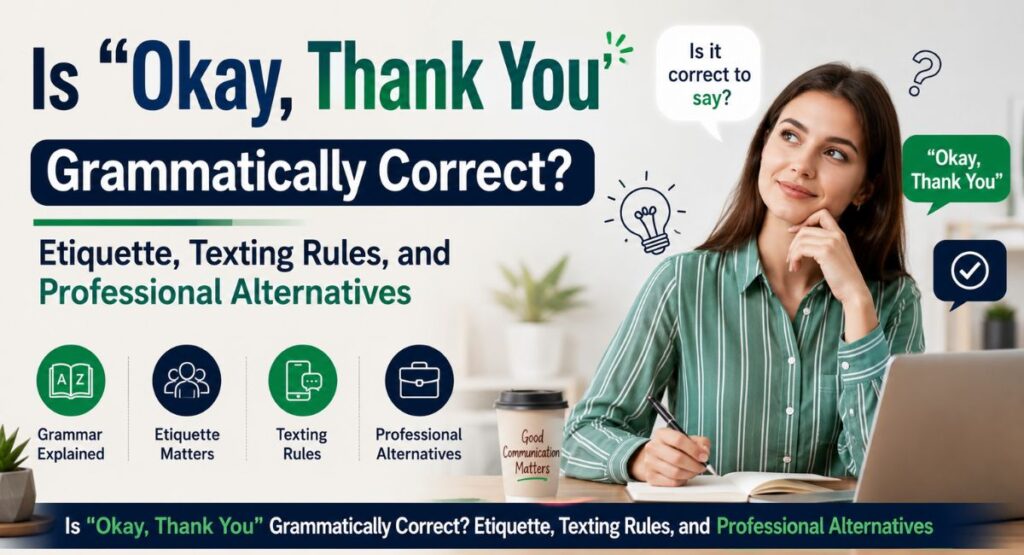
We use it dozens of times a week. It is the default, muscle-memory response to an Uber driver letting you know they’ve arrived, a colleague dropping a file in Slack, or a parent texting you a grocery list.
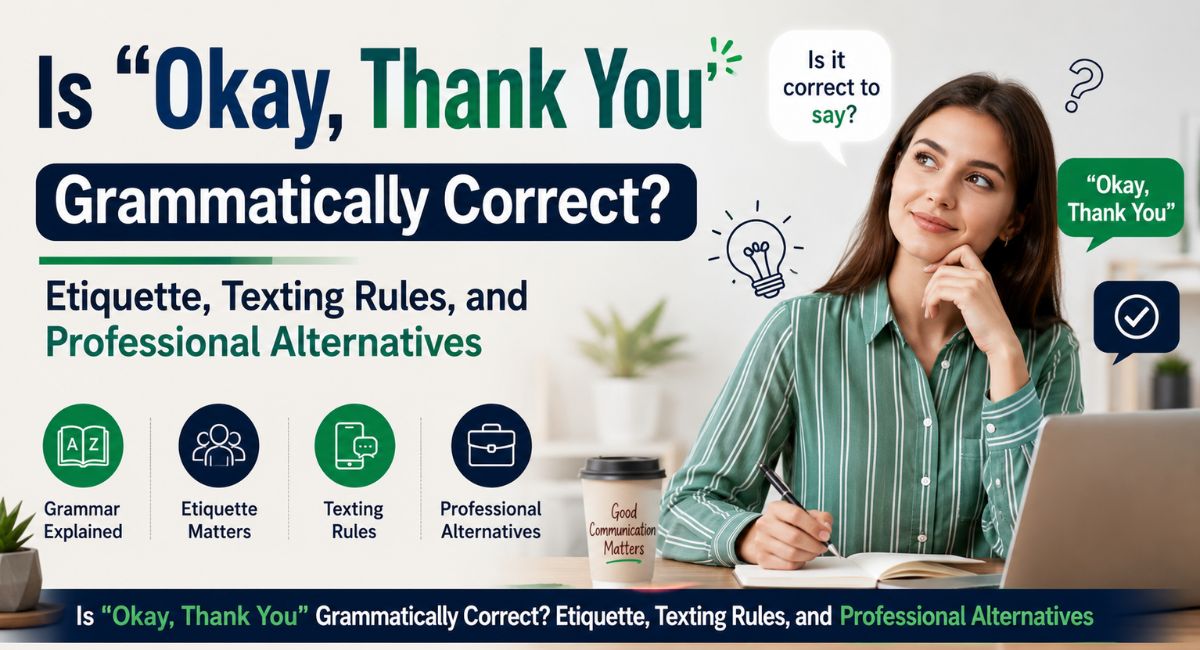
But is “okay thank you“ actually grammatically correct? Or does it cross the line from a quick, efficient acknowledgment into something slightly passive-aggressive, cold, or unprofessional?
Under the lens of the June 2026 Google Search updates, which demand deep informational gain over generic fluff, we are bypassing the surface-level grammar answers. This article breaks down the syntax, punctuation, digital texting etiquette, and situational alternatives you need to know to ensure your short messages always leave the right impression.
1. The Quick Answer: Is It Grammatically Correct?
Yes, “Okay, thank you” is grammatically correct. However, how you write it determines whether it is technically flawless or a bit messy.
The phrase is composed of two distinct grammatical elements:
- “Okay” (or “OK”): An interjection or adjective used for agreement or acknowledgment.
- “Thank you”: A shortened, conventionalized clause expressing gratitude (originally short for “I thank you”).
Because these are two separate, independent thoughts, throwing them together without proper punctuation is technically a comma splice or a run-on sentence.
How to Punctuate It Correctly
To be grammatically perfect in formal writing, you have three distinct options:
- The Comma (Standard & Natural):
"Okay, thank you."(Best for general emails and text messages) - The Period (Strong & Direct):
"Okay. Thank you."(Adds deliberate weight to the thank you) - The Semicolon (Formal):
"Okay; thank you."(Rarely used in modern texting, but technically correct)
Avoid writing "okay thank you" with zero punctuation in professional settings, as it can look rushed or careless.
2. “OK” vs. “Okay”: Which is Better?
The spelling you choose shifts the tone of your message more than you might think. Both are acceptable, but they carry different visual weights:
- “Okay” (The Modern Standard): Spelling it out feels softer, warmer, and more intentional. If you are writing a professional email or messaging a client, stick to “okay.”
- “OK” (The Historic Original): Originating in the 1830s as a slang abbreviation for “oll korrect” (all correct), “OK” is punchy and highly efficient. However, in modern texting culture, an uppercase “OK” can sometimes feel sharp or demanding.
- “Ok” or “ok” (The Casual Default): This lowercase format is strictly for casual texting with friends. Avoid using “ok” in work emails, as it can look highly informal or lazy.
3. The Texting Etiquette: Does “Okay, thank you” Sound Passive-Aggressive?
In digital communication, we lack the physical cues of tone, facial expressions, and body language. Because of this, short text messages are heavily prone to negative bias. If a message can be read as cold, the recipient will often assume it is.
Depending on who you are texting, “Okay, thank you” can land in very different ways:
The Gen Z / Text-Savvy Perspective
For younger generations or highly active digital communicators, a period at the end of a short sentence indicates finality, frustration, or a flat tone.
Sending
"Okay, thank you."with a period to a Gen Z colleague might make them worry they did something wrong.
In casual environments, omitting the period ("Okay, thank you!" or "Okay, thanks") prevents the message from feeling like a conversation killer.
The Professional Perspective
In a workplace setting, brevity is often respected as efficiency. However, overusing “Okay, thank you” in a thread can make you sound like a robot. If a client goes out of their way to solve a complex issue, a brief “Okay, thank you” can feel incredibly dismissive.
4. Tone-Shifting Alternatives
Many basic grammar guides simply tell you to swap “Okay, thank you” with “Thanks.” But language is highly contextual.
Let’s look at exactly how to upgrade this phrase based on who you are communicating with, ensuring you match their energy perfectly.
| Recipient / Context | Instead of “Okay, thank you,” try… | Why it works |
| Your Manager / Boss | “Understood, thank you for the update.” | Confirms comprehension while maintaining professional boundaries. |
| An Important Client | “Got it, thank you so much for the clarification.” | Expresses proactive alignment and shows you value their time. |
| A Stressed Colleague | “Perfect, thanks! I’ll take it from here.” | Relieves their cognitive load and sounds collaborative. |
| A Close Friend | “Awesome, thank you!” or “Sounds good, thanks!” | Positive, energetic, and highly natural. |
| Customer Support | “Thank you, that clears up my question.” | Signals that their job is successfully done. |
5. Frequently Asked Questions
Is “okay, thank you” one sentence or two?
Grammatically, they are two separate clauses. If you write them as "Okay, thank you," you are using a comma to bridge a conversational pause. Technically, writing them as two sentences ("Okay. Thank you.") is the most formally correct construction, but the comma-separated version is highly accepted in digital writing.
Can I write “K, thanks”?
Only to close friends or family in rapid-fire text exchanges. Using “K” or “K, thanks” in any professional setting is widely considered rude, dismissive, or passive-aggressive because it implies you cannot spare three seconds to type a polite response.
How do I reply to “Okay, thank you”?
If you are the sender and someone replies with “Okay, thank you,” the loop is closed. You do not need to reply to this message. However, if you want to be polite in a professional chat, a simple thumbs-up emoji (👍) or a quick “You’re welcome!” is a perfect way to end the thread.
The Takeaway
“Okay, thank you” is a perfectly valid, grammatically correct phrase. But in modern communication, correctness is only half the battle. The secret of great digital communication is matching your warmth to the situation.
When you need to keep it brief, "Okay, thank you" gets the job done. But if you want to build stronger relationships at work and online, taking two extra seconds to expand your response into “Understood, thank you!” or “Perfect, thanks for getting back to me” goes a very long way.