If you spend even a few minutes scrolling through TikTok, YouTube Shorts, or Twitch streams, you are bound to encounter a barrage of unfamiliar words. Terms like rizz, sigma, and skibidi dominate comment sections, but few have sparked as much confusion, misuse, and rapid evolution as “gyatt” (often stylized as GYATT or GYAT).
For general internet users, parents, or anyone trying to decode text-savvy Gen Z and Generation Alpha conversations, the word can seem like utter gibberish. Compounding the confusion, many online resources—including older competitor articles—provide outdated or oversimplified definitions.
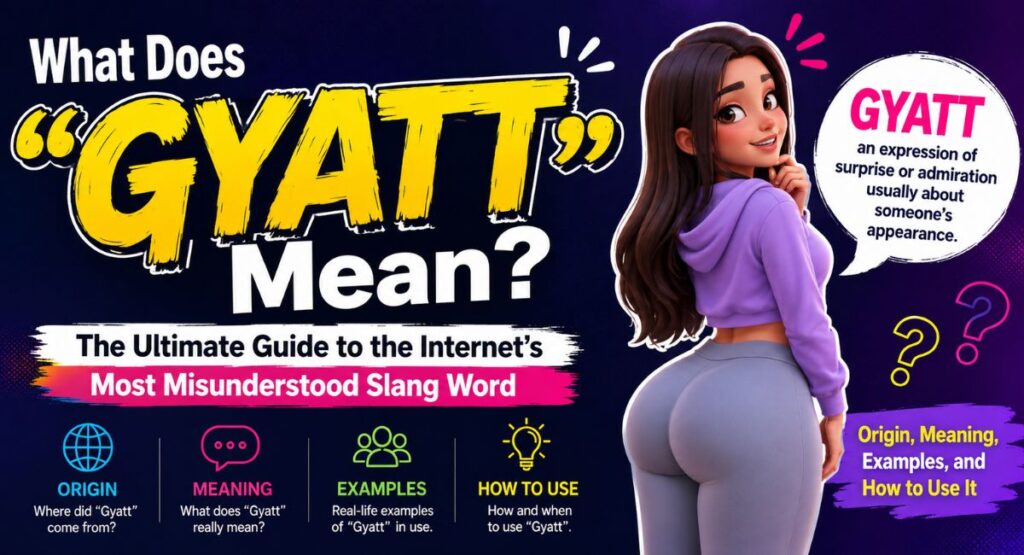
To satisfy your search intent immediately: In its primary modern form, “gyatt” is internet slang used to describe a person with an attractive, curvy, or large backside (buttocks). However, it originated simply as a shortened, high-energy abbreviation for the exclamation “Goddamn!”
To truly understand how to use it, spot it in the wild, and avoid a major digital faux pas, we need to dive into its linguistic mechanics, history, and real-world usage.
The Two Distinct Meanings of “Gyatt”
To understand this term, you must realize it serves two entirely different grammatical functions depending on the context.
1. The Original Meaning: An Exclamation of Surprise
Originally, “gyatt” was not a noun or an adjective. It was purely an interjection. It represents a phonetic spelling of how someone might yell “Goddamn!” when they are shocked, excited, or hyped up. In this context, it is roughly equivalent to saying:
- “Holy cow!”
- “Wow!”
- “Oh my goodness!”
2. The Modern Shift: A Noun/Adjective for Attraction
Through rapid meme culture and internet fragmentation, the term underwent a dramatic semantic shift. Because streamers frequently yelled the exclamation upon seeing an attractive person, the word itself became synonymous with the physical trait being admired.
Today, online communities use it as a noun to directly reference a voluptuous figure (e.g., “Look at that gyatt”).
Origin and Evolution: From Twitch to “Brainrot” Culture
The word did not emerge out of thin air. Sociolinguistic research tracking digital language variations reveals a clear timeline of how the slang trickled down into the mainstream.
The AAVE and Streamer Roots
Long before it hit TikTok, variations of the phrase were rooted in African American Vernacular English (AAVE), frequently used by Black creators to express intense emphasis or disbelief.
The term exploded globally between 2021 and 2023 due to prominent live-streamers on Twitch, most notably Kai Cenat. During high-energy broadcasts, whenever a curvy person appeared on screen or a wild event occurred in a video game, Cenat would slam his desk and draw out the phrase: “GYAAATTT!”
The Transition to Gen Alpha “Brainrot”
By 2024 and 2025, the word transitioned fully from Gen Z streamer culture into Generation Alpha vocabulary. It became embedded in a structural lexicon known colloquially as “brainrot”—a hyper-referential, fast-paced stream of internet memes. Linguistic patterns indicate that these abbreviated, monosyllabic words are easily adopted because they convey intense emotion or urgency with minimal conversational effort.
The word was even immortalized in the viral “Sticking Out Your Gyat for the Rizzler” parody song, cementing its place in the modern youth lexicon.
Actionable Examples: How It Is Used in Real Life
To help distinguish how the word shifts in meaning, here are everyday examples of the slang in text messages and social media comments:
Scenario A: Used as a Noun (Modern Visual Reference)
- The Comment: “Bro walked into the gym and saw a certified gyatt.”
- The Translation: “That person noticed someone with a very impressive, fit, or curvy physique at the gym.”
Scenario B: Used as a High-Energy Interjection (Original Context)
- The Text: “GYAT! Did you see that clutch play at the end of the tournament?!”
- The Translation: “Wow! Did you see that amazing, unexpected winning move at the end of the game?!”
What Most Articles Missed: Frequently Asked Questions
Many surface-level dictionary sites gloss over the structural nuances of online slang. Below are the hidden queries and deeper context most competitors miss.
Is “gyatt” an acronym?
No. A common misconception online is that GYATT stands for “Get Your Act Together” or “Girl, You Are Thick.” These are backronyms—phrases invented after the fact to fit the letters. The word is entirely a phonetic spelling of a vocal exclamation (“God-damn”).
Is the word considered inappropriate or vulgar?
Context is critical. While it isn’t a profanity or an explicit swear word, its modern usage is highly objectifying, as it explicitly draws attention to someone’s body parts. Using it in professional, academic, or formal settings is highly inappropriate. Furthermore, linguistic field studies show that while youth widely use these terms online, they simultaneously view them as “cringe” or childish when used out of context or by older generations.
What is a “Gyatt Level 30”?
In gaming and TikTok meme circles, users often attach arbitrary numbers or levels to the word (e.g., “Level 30 Gyatt”). This is simply internet hyperbole used to exaggerate the scale or impressive nature of whatever is being reacted to. It holds no real mathematical or official classification.
How do Gen Z and Gen Alpha use it differently?
Gen Z typically uses the word with a layer of irony or explicitly references the streamer culture it came from. Generation Alpha treats it as a native, foundational building block of their vocabulary, often combining it seamlessly with other terms like rizz (charisma) or fanum tax (stealing food).
Summary: A Quick Cheat Sheet
If you need a rapid breakdown to remember for later, keep this matrix in mind:
| Attribute | Quick Breakdown |
| How to Pronounce It | Sounds like “Gee-yot” or a drawn-out “Gee-ah-h-t” |
| Primary Meaning | An attractive, curvy lower body |
| Secondary Meaning | An energetic expression of shock or awe (“Goddamn!”) |
| Where You’ll See It | TikTok comments, Twitch chats, YouTube Shorts, and Discord |
| Social Rule | Do not use it in professional settings; expect eye-rolls if you use it over the age of 25. |
Conclusion
At its core, “gyatt” represents the astonishing speed at which language evolves in a hyper-connected digital landscape. What started as a regional vocal inflection was amplified by live-streaming culture, compressed by internet algorithms, and ultimately transformed into an entirely new part of speech by younger generations.
Whether you view it as fascinating linguistic evolution or generic internet background noise, understanding its double meaning ensures you won’t be left in the dark the next time it pops up on your feed.